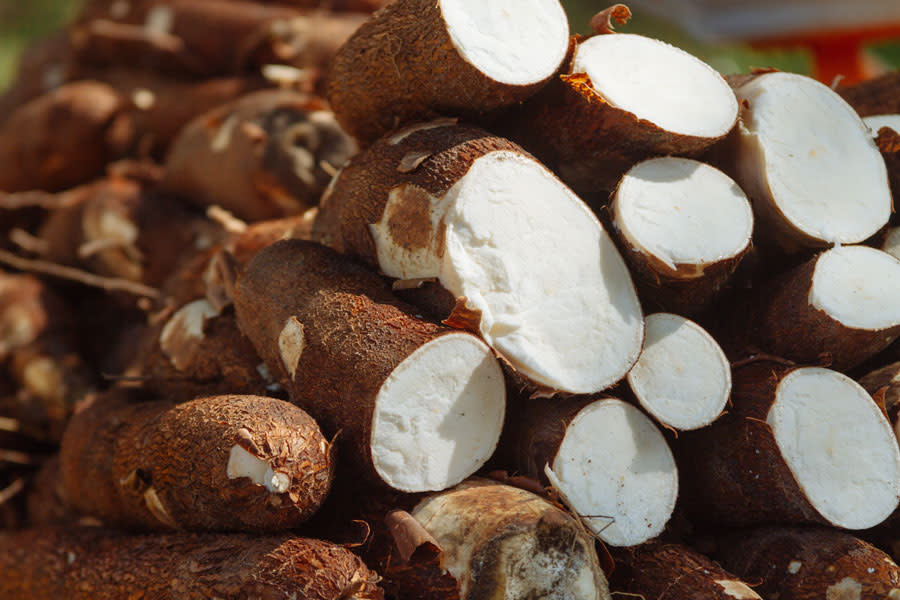
Cassava root is a versatile ingredient that goes by several other names, and it’s often confused with other foods. Here’s a breakdown of the different names and uses for cassava root, and an overview of common misconceptions about cassava.
Key Takeaways
Cassava and yuca are the same root vegetable — also known as manioc, Manihot esculenta, and Brazilian arrowroot — making them a single starchy tuber that serves as a staple crop across South American, African, and Asian cuisines — the multiple names create widespread confusion, but all refer to one plant with one nutritional profile
Yuca is frequently confused with yucca, but yucca is an evergreen shrub entirely unrelated to cassava root — this one-letter spelling difference is the single most common naming error and leads to incorrect recipe substitutions and product searches
Tapioca is a starch extracted from cassava root, while cassava flour uses the whole root — a distinction that matters for gluten-free baking because whole-root cassava flour behaves differently than refined tapioca starch — cassava flour is naturally gluten-free and grain-free, making it a versatile wheat flour substitute for breadings, baked goods, and flatbread crusts
What is cassava nutritionally: it is a high-carbohydrate, calorie-dense root vegetable in the same family as potatoes, sweet potatoes, taro, and yams — its neutral, nutty flavor and versatile texture make it equally suited for roasting, mashing, and flour-based applications in both traditional and gluten-free cooking
What is Cassava?
Cassava is a nutty-flavored, starchy vegetable in the root and tuber family. Other vegetables in this group include potatoes, sweet potatoes, taro, and yams. Cassava is high in both carbohydrates and calories compared with other vegetables, and it is a staple crop in many cultures across the globe.
Other Names for Cassava
Cassava is also called yuca, manioc, Manihot esculenta, or Brazilian arrowroot. The term Brazilian arrowroot can be confusing, as cassava is not used to make arrowroot starch, which comes from West Indian arrowroot or Maranta arundinacea.
On the other hand,tapiocais a starch extracted from cassava root, and tapioca flour is made from cassava root.
The name yuca is commonly confused with yucca, which is not a root vegetable but an evergreen shrub and is entirely different from cassava. Make sense?
Uses for Cassava
Cassava root can be cooked and eaten as a starchy side - similar to mashed or roasted potatoes - and it’s also used to make different types of flours.
Cassava flour is made from the whole root of the cassava plant. Just like cassava root, cassava flour is gluten-free and grain-free, making it an excellent alternative to wheat flours for people who cannot tolerate gluten. Cassava flour is widely used in gluten-free baking and it can be used as a gluten-free substitute for breadings or breadcrumbs. The Daily Harvest Flatbread collection utilizes cassava flour to create nutritious gluten-free crusts.
Tapioca starch, which is the same thing as tapioca flour, can be used in gluten-free baking, or as a thickener in soups and stews.
We take care of food so food can take care of you. Stock up on our deliciously nourishing cassava-based bestsellers ondaily-harvest.com.
Sources
Important Notes: Unless otherwise noted, nutrition information is sourced from USDA FoodData Central and reflects the reference amount customarily consumed. These are standardized servings and not necessarily the amount present in the highlighted Daily Harvest recipes. Nutrition information for Daily Harvest products can be found on packages and under "Nutrition Facts" for each product at "daily-harvest.com". Vitamin and mineral functions are sourced from Linus Pauling Institute Micronutrient Information Center.
Find out how to make a smoothie without yogurt while keeping it thick, creamy, and delicious. Explore dairy-free options for your next healthy blend.
all
Do Meal Kits Save Money?
By Daily HarvestUpdated:
recipe
High Protein & Fiber Overnight Oats
By Christina Gutierrez-WilliamsUpdated:
The information provided on Daily Harvest’s website, emails, social media, or any other platform should not be construed as medical or nutritional advice, diagnosis, or treatment. Please consult with a qualified healthcare professional regarding your diet, including adopting a new eating plan or imposing dietary restrictions.
Thanks for the second chance
View BoxPlan settings
Change Next Delivery Date
When would you like your next delivery?
Note On Your Existing Order
Order #{{number}} for your most recent box has already been processed and is still scheduled to arrive {{date}}.
Note On Your Pending Placement Order
Your pending placement order is still scheduled to arrive {{date}}.
I understandSaveCancel
GET IT SOONER
Your order will be placed immediately with an estimatedarrival of:We'll alert you as soon as your order is confirmed. You'll continue to receive boxes every {{cadence}} after.
Need to cancel? Contact Care.PLACE ORDEREDIT BOXCANCELProcessing...
DELIVERY RESCHEDULED!
Your next order will arrive on:We'll alert you as soon as the box is confirmed. You'll continue to receive boxes every {{cadence}} after.
Order #{{number}} for your most recent box has already been processed and is still scheduled to arrive {{date}}.
Note On Your Pending Placement Order
Your pending placement order is still scheduled to arrive {{date}}.
I understandSaveCancel
GET IT SOONER
Your order will be placed immediately with an estimatedarrival of:We'll alert you as soon as your order is confirmed. You'll continue to receive boxes every {{cadence}} after.
Need to cancel? Contact Care.PLACE ORDEREDIT BOXCANCELProcessing...
DELIVERY RESCHEDULED!
Your next order will arrive on:We'll alert you as soon as the box is confirmed. You'll continue to receive boxes every {{cadence}} after.